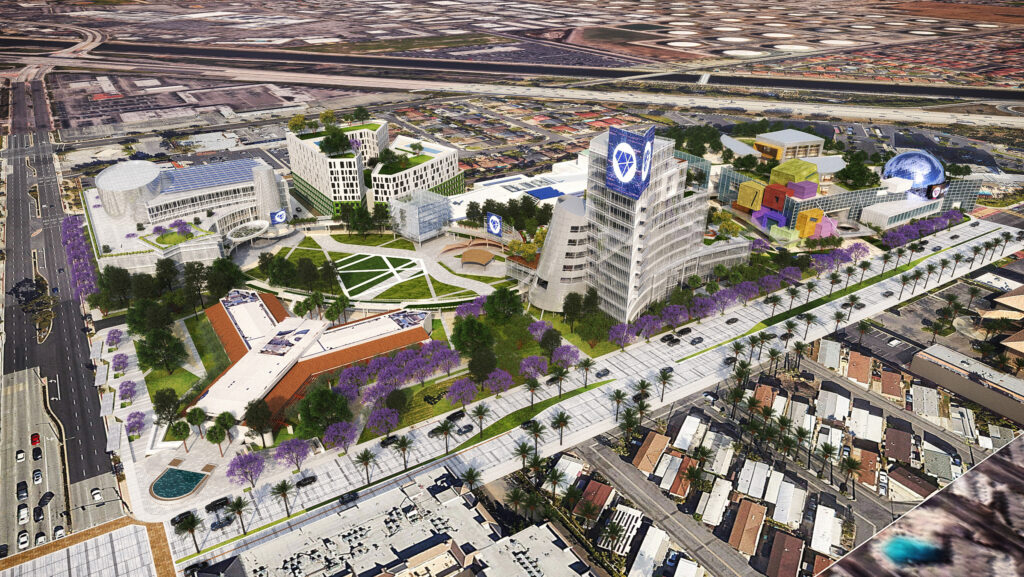
An architectural rendering illustrates the City of Carson’s proposed Civic Center transformation, envisioned to include a new City Hall, performing arts center, residential development, commercial space and public gathering areas. The approximately 20-acre redevelopment is among the major economic development initiatives discussed by city leadership during an exclusive interview with the Carson Compass.
Carson, CA — For decades, Carson has been home to major industries, distribution centers, educational institutions and businesses that help drive Southern California’s economy. Yet for city leaders, the question guiding Carson’s next chapter is no longer simply how much development the city can attract, but whether that growth will translate into greater opportunity for the people who call Carson home.
In an exclusive interview with the Carson Compass, City Manager David Roberts, Deputy City Manager Armine Chaparyan, and Community and Economic Development Director Nathan Freeman outlined an ambitious economic development strategy centered on revitalizing the city’s Civic Center, attracting major employers, expanding technology infrastructure, creating sustainable jobs and ensuring that residents share in the benefits of new investment.
The conversation also included Reata Kulcsar, the city’s energy and sustainability officer, who detailed efforts to connect large-scale development with practical programs that support Carson households.
Together, the officials described a city they believe is entering a pivotal period of transformation, one shaped by stronger municipal finances, renewed economic development priorities and an effort to position Carson as a destination rather than simply a community motorists pass through.
Asked to compare Carson’s economic position today with where it stood five or ten years ago, Roberts pointed to the city’s improved financial standing as a significant turning point.
“The city wasn’t in the financial position that it is today to be able to even consider some of the potential opportunities that sit before us,” Roberts said.
That improved position, he explained, has allowed the city to pursue economic development opportunities that previously may have been beyond its reach.
Roberts also emphasized the importance of experienced leadership in translating the vision of the mayor and City Council into tangible projects. He called Freeman one of the top economic development directors around and said it was probably the first time the city has had a professional of his experience in that position.
But the city manager’s vision extends beyond traditional development.
Rather than focusing exclusively on housing, retail and commercial investment, Roberts wants Carson to emerge as a leader in technology, innovation and sustainability.
That is one reason, Roberts said, he brought in Kulcsar to lead innovation and sustainability work, giving her room to pursue technology and innovation projects that might otherwise bog down the community development department, and that some cities may be hesitant to take on.
A central component of that effort is the city’s developing fiber-optic network, which officials envision as both a public service and an economic development asset.
Roberts said the network could provide the foundation for future technological initiatives, strengthen the city’s ability to attract businesses and expand access to reliable internet service for residents. He added that the city will own the network and run it as an enterprise fund, with additional projects to be built on it, including tools for CarsonX, the city’s programming tied to the 2028 Olympic and Paralympic Games.
His hope is that Carson will eventually be recognized nationally for its approach to technology and innovation.
Among the most significant projects currently being advanced is the proposed redevelopment of Carson’s Civic Center campus.
Freeman confirmed that the city has narrowed its search for a master developer to two finalists following a solicitation process that drew multiple responses.
At the time of the interview, officials anticipated making a recommendation to the City Council by the end of 2026 or early 2027.
The proposed redevelopment could include a new City Hall, performing arts theater, hundreds of apartments, thousands of square feet of potential retail space and a hotel.
For Freeman, the project’s importance extends beyond new public facilities.
It represents an opportunity to create a more vibrant downtown environment that supports businesses, attracts visitors and encourages residents to spend more time and money within Carson.
“It will, at a minimum, revitalize downtown,” Freeman said.
He explained that a successful Civic Center redevelopment could also create the economic conditions necessary to attract the types of restaurants and amenities residents have repeatedly requested.
Among those priorities are more full-service, sit-down restaurants.
Freeman noted that a sit-down restaurant needs customers throughout the day, not just in the evening. “You need a lunch crowd too. You can’t just have a dinner crowd,” he said.
“If we have more people living in Carson, working in Carson and spending their money here, then a Joey’s is not an unreasonable thing,” he said, referring to the restaurant the mayor has said she wants to see in Carson.
For Freeman, the principle is straightforward: a healthy local economy depends on people living, working and spending in the same community.
Roberts added that the city is on the verge of several major announcements he could not yet disclose, describing them as “game changers.”
Freeman also said that on the morning of the interview he had spoken with a major corporation that wants to relocate to Carson, a move he said would employ hundreds of people and generate millions of dollars in sales tax revenue for the city. He did not name the company.
That interconnected approach is helping shape the city’s recruitment and redevelopment efforts.
Another major focus is the redevelopment of underutilized industrial property, including the approximately 157-acre area associated with the District at South Bay project.
During the interview, Roberts discussed the significance of the City Council-approved light industrial development, totaling nearly 1.6 million square feet, and its potential to generate employment opportunities, infrastructure improvements and recurring revenue.
He described the project as an opportunity to create an economic engine on land he described as long desolate, where the city had missed out on several major opportunities in the past.
Beyond the immediate revenue, Roberts said, the project represents “a legacy type of revenue” that can sustain the city over time.
Freeman also discussed ongoing negotiations involving the redevelopment of the former Phillips 66 site, where he said the city is “down to the one-yard line” in negotiating a comprehensive community benefits package.
For Carson, a city with a long history of industrial activity, the redevelopment of such properties carries particular significance.
Freeman acknowledged the importance of ensuring that land historically associated with negative community impacts can produce meaningful and lasting benefits.
“How do you qualify community benefits for something that has had such a negative impact on our community for so long?” he asked.
The answer, he suggested, cannot be limited to a financial contribution.
“It’s not just, hey, just write the city a check,” Freeman said.
Instead, officials are pursuing commitments that could include jobs, workforce training and other community-focused investments.
“What we want is a sustainable, long-term, positive community impact,” he said.
At the time of the interview, the community benefits agreement remained under negotiation, and specific commitments had not been finalized.
While major developments often generate excitement around investment and construction, they also raise an important question: What will residents actually receive in return?
That question was central to the Carson Compass interview.
Freeman said the city is making local employment opportunities an early priority in conversations with prospective developers and major employers.
“One of the things that we address immediately up front is our desire that Carson residents have a first crack at that employment,” he explained.
Community benefits negotiations, he said, are intended to translate private development into measurable public value.
Those benefits can take several forms, including jobs and direct payments, all of which, he said, get cycled back to the community.
Freeman also emphasized that new businesses can contribute to the tax revenues necessary to support essential public services, including public safety and street improvements.
The goal is to create a cycle in which economic development strengthens municipal resources while improving residents’ quality of life.
Still, the distinction between the city’s aspirations and guaranteed outcomes remains important.
Although officials described local hiring as a priority, the interview did not establish specific hiring percentages, wage commitments or timelines for individual developments.
Those details will ultimately help determine whether the city’s economic development strategy delivers the benefits residents have been promised.
Of all the initiatives discussed, Roberts returned repeatedly to Carson’s fiber-optic network.
He described the investment as one of the city’s most consequential opportunities to close the digital divide while positioning Carson for technological growth.
The city-owned network is intended to serve residents, small businesses, larger employers and institutions, including California State University, Dominguez Hills.
Roberts discussed the potential for high-speed connectivity ranging from one to ten gigabits, offering businesses and institutions infrastructure capable of supporting increasingly demanding technological needs.
He also said more than 1,100 homes under development are expected to incorporate smart-home technology connected to the city’s fiber infrastructure.
Beyond speed and convenience, Roberts emphasized affordability and access.
For families with students completing homework online, seniors relying on digital services and small businesses conducting transactions, reliable internet access has become essential to everyday life.
“We’re trying to connect our community,” Roberts said.
He argued that the public purpose of the network distinguishes it from traditional commercial internet services.
“For us, it’s not about profitability. It’s about reliability and connection,” he said.
Roberts acknowledged that the network has drawn the ire of major telecommunications providers, which he said are angry with the city because it is, in essence, undercutting their profits.
The network could also become a competitive advantage as Carson seeks to attract companies that depend on modern digital infrastructure.
Although officials expressed confidence in the project, specific residential subscription rates, network availability dates and citywide implementation milestones were not established during the interview.
Freeman offered one of the clearest explanations of the city’s economic development philosophy when discussing the types of businesses Carson is actively seeking.
He said the city should be evaluated not only by the development it welcomes but also by the projects it determines are not the right fit.
“We want to be known for what we bring here and just as importantly, what we don’t bring here,” Freeman said.
He pointed to the rapid growth of car washes and fast food, noting that Carson, working with the city manager’s office and City Council, enacted moratoriums on car washes and drive-throughs.
Freeman stressed that such businesses are not inherently undesirable, but that communities must consider whether they have reached a point of saturation.
“How many is too many?” he asked.
According to Freeman, residents have consistently expressed interest in more sit-down restaurants, better employment opportunities and businesses that contribute to the community’s long-term economic health.
That feedback has influenced the city’s business recruitment efforts, including at the International Council of Shopping Centers conference, where Freeman said city staff deliberately passed on meetings with fast-food chains such as McDonald’s and Burger King.
Rather than focusing exclusively on businesses that are expanding aggressively, Freeman said the city is working to recruit establishments that align with residents’ priorities.
“We want development that creates job opportunities for local residents, sustainable ones that pay a living wage,” he said.
Asked whether that includes health care benefits, Freeman said it does, calling health care an integral part of a thriving economy.
The emphasis reflects a broader shift toward evaluating economic development through quality-of-life outcomes rather than simply counting new businesses.
Attracting major employers is only one part of the city’s economic strategy.
Roberts said Carson must also ensure that locally owned businesses have opportunities to grow alongside larger corporations.
He pointed to the importance of connecting small businesses with established companies that may be able to provide mentorship, technical assistance and opportunities for collaboration.
Among the initiatives he referenced was a town-and-gown partnership led by the mayor and the former president of California State University, Dominguez Hills, which created a business academy for small-business owners and which he said continues today.
The effort included business education opportunities intended to help entrepreneurs strengthen the practical skills required to operate and sustain successful businesses.
Roberts said that while many residents possess entrepreneurial ambition, they may not always have access to the training, resources or professional networks needed to expand their enterprises.
He envisions a system in which larger companies entering Carson can help support local entrepreneurs through partnerships, knowledge sharing and other resources.
“Everyone knows that the heartbeat of a community is a small business,” Roberts said.
The objective, he explained, is to ensure that smaller businesses are not overlooked as the city pursues larger-scale investment.
Roberts said the city has also insisted that support for small businesses be included in the community benefits written into development agreements with incoming companies, so that local enterprises do not fall by the wayside.
For Freeman, community engagement also plays an essential role in determining which businesses and development opportunities the city should pursue.
He emphasized that economic development staff should approach their work from the perspective of the people they serve.
Rather than assuming city officials know what businesses are best suited for Carson, he said listening to residents must remain central to the decision-making process.
Asked how the city is balancing growth with concerns about traffic, infrastructure and environmental impacts, Roberts said projects will go through environmental impact reports and traffic studies, which he described as standard procedures the city is happy to follow. He said Carson is one of very few cities with a dedicated innovation and sustainability division and is working to attract environmentally friendly, clean-energy businesses.
While many of Carson’s economic development projects involve substantial construction and long-term investments, Kulcsar described several initiatives designed to provide more immediate benefits to households.
One is the city’s electric vehicle charging wallet pilot program, approved by the city last year, which offers residents who drive electric vehicles up to $250 in reimbursement for using publicly accessible city charging stations.
Kulcsar said no city in Los Angeles County other than the City of Los Angeles and the county itself has as many publicly available EV charging stations at its parks, community centers and other facilities.
Another initiative involves replacing gasoline-powered lawn equipment with electric alternatives.
The city has secured grant funding for the program, which Kulcsar said is intended to allow Carson residents to exchange equipment such as gas-powered lawnmowers and leaf blowers for electric versions at no cost.
At the time of the interview, the City Council had already approved the grant funding, but the program guidelines were still being developed and must return to the council for final approval.
Kulcsar also highlighted a community solar initiative involving Prologis and the Clean Power Alliance.
Under the program, solar arrays at Prologis facilities in Carson produce clean energy. Qualifying low-income Carson households can receive a 20 percent reduction on their electricity bills simply by signing up, with no equipment to install and no contract.
Kulcsar said approximately 1,500 households could be served through the program, while just under 6,000 Carson households could meet the income qualifications.
Asked whether capacity could grow, she said the state program behind the initiative has since been phased out, but Carson was grandfathered in because it enrolled early.
Nevertheless, the program offers an example of how large commercial properties can contribute to direct household savings.
For Kulcsar, that balance is essential.
The city must continue pursuing transformational projects, she said, while remembering the everyday needs of the people who live there.
Chaparyan described another dimension of the city’s emerging economic strategy: positioning Carson as a destination for clean technology, sustainable investment and international partnerships.
She said the fiber-optic network provides an important foundation for attracting companies involved in innovation, clean energy and related industries.
Chaparyan also noted that Carson’s increasing international visibility presents opportunities to introduce the city to businesses and organizations that might not otherwise consider locating there.
“We are open for business. We are open for international partnerships,” she said.
Her comments reflect a broader effort to distinguish Carson within Southern California’s competitive economic development landscape.
Rather than relying solely on its existing industrial base, the city hopes to attract investment that supports new technologies, sustainability and long-term economic diversification.
Chaparyan tied that effort directly to the 2028 Olympic and Paralympic Games, saying the city wants to use the international attention, including delegations from other nations already visiting Carson, to showcase what it has under way.
Near the conclusion of the conversation, city leaders were asked to consider a straightforward measure of accountability.
If the Carson Compass returned in three years, what tangible improvements should residents be able to identify as evidence that the city’s economic development strategy is working?
Roberts again pointed to the fiber-optic network.
He said he hopes residents who previously lacked affordable, reliable internet service will be connected, students will be better equipped to learn from home, seniors will have greater access to digital resources and local businesses will benefit from modern technology.
Those outcomes, he suggested, would represent a meaningful measure of progress.
Roberts also pointed to the Games. Chaparyan has been leading CarsonX, the city’s programming tied to LA28, and Roberts said the city expects to welcome more than 1.7 million visitors, including international dignitaries, many of whom will be experiencing Carson for the first time. His hope, he said, is that they leave seeing the city as a jewel many people do not know about.
Elsewhere, the city’s success will be judged by whether development proposals move from planning to construction, whether major employers establish operations in Carson, whether residents secure quality jobs and whether public revenues support visible improvements in neighborhoods.
The proposed Civic Center redevelopment, industrial property reuse, small-business initiatives and sustainability programs collectively represent an economic vision with significant potential.
But much of that vision remains dependent on negotiations, development approvals, implementation schedules and the ability to convert anticipated investments into lasting community benefits.
For residents, the most meaningful measure may ultimately be simpler than the size of a development or the dollar value of an investment.
It may be whether they can find better-paying work closer to home, access affordable technology, support thriving neighborhood businesses, enjoy more dining and entertainment options, and see improvements in the public services their families rely upon.
That is the central challenge facing Carson as it seeks to redefine its economic future.
The city has outlined an ambitious vision. The next chapter will be determined by how much of that vision becomes reality—and how widely its benefits are shared.