
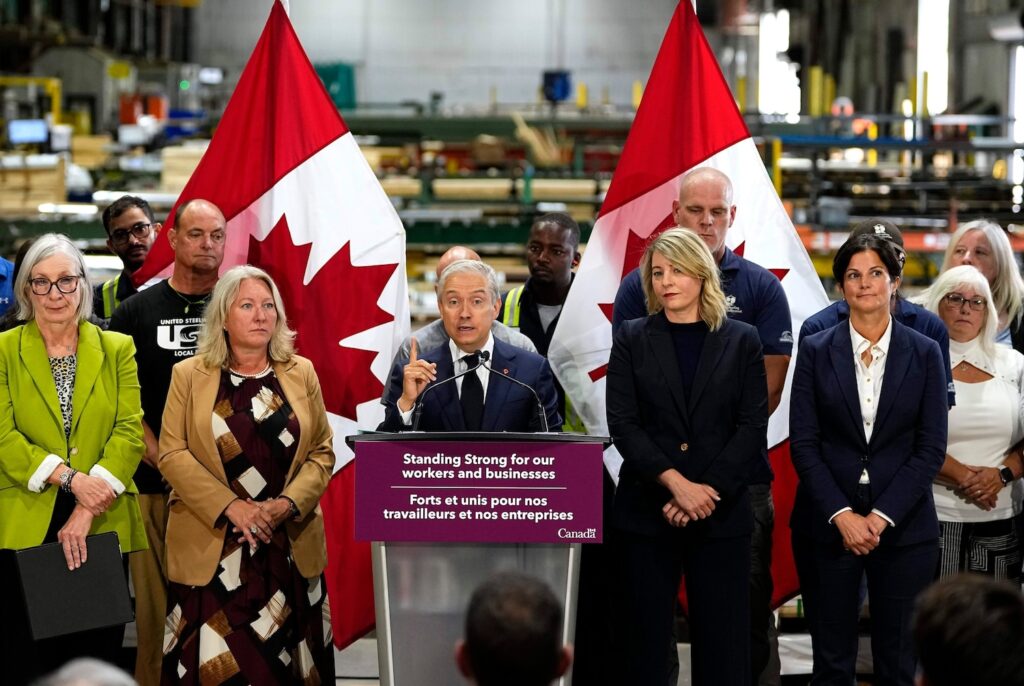
Minister of Finance and National Revenue Francois-Philippe Champagne speaks at a news conference on Canada’s response to U.S. tariffs, at a roofing company in Ottawa, Aug. 25, 2026. / Justin Tang/The Canadian Press via AP
Carson, CA — A growing trade dispute between the United States and Canada is moving beyond Washington and Ottawa, with potential consequences for Southern California ports, businesses and consumers — including those in Carson and the surrounding South Bay.
Canada imposed new retaliatory tariffs Tuesday on C$27.6 billion worth of American goods after the United States placed 50% tariffs on a comparable value of Canadian products beginning Aug. 22.
The Canadian counter-tariffs range from 15% to 50% and affect products including steel, dairy goods, appliances, agricultural equipment, pulp and paper, plastics and electronics. Canada says the measures are designed to match U.S. tariffs dollar for dollar.
While the dispute centers on trade between the two countries, Southern California’s deeply interconnected logistics economy means the effects could reach communities far from the Canadian border.
That includes Carson.
The city sits within one of the nation’s most important freight and industrial corridors, only miles from the ports of Los Angeles and Long Beach and directly connected to the I-405, I-710 and regional rail and trucking networks.
The San Pedro Bay port complex supports an estimated 990,000 jobs across Los Angeles, Orange, Riverside, San Bernardino and Ventura counties, according to Port of Los Angeles data. The two ports also handled approximately 31% of U.S. containerized international waterborne trade in 2025.
Although Canada is not among the Port of Los Angeles’ largest trading partners, trade moving through the port between Canada and Los Angeles nearly doubled in value in 2025, increasing about 90% to roughly $972 million, according to the port’s annual trade report.
That makes the latest round of tariffs worth watching in communities such as Carson, where logistics, trucking, warehousing, manufacturing and industrial development are significant parts of the local and regional economy.
Tariffs are taxes imposed on imported products. The importer typically pays the tariff at the border, but businesses can respond by absorbing the added cost, changing suppliers or passing some or all of the increase on to customers.
That means a tariff imposed hundreds or thousands of miles away can eventually influence the price of materials, equipment or finished goods sold in Southern California.
Steel and electronics are among the products included in Canada’s latest measures, potentially affecting U.S. manufacturers and suppliers selling north of the border. Canadian businesses purchasing American products could reduce orders or seek alternatives if those goods become more expensive.
The reverse is also true for U.S. businesses importing Canadian products subject to American tariffs.
For Southern California companies operating across manufacturing, construction, distribution and transportation, additional costs or changing trade patterns can reverberate through the supply chain.
The Port of Los Angeles has already experienced volatility tied to tariff uncertainty. Port officials have previously described businesses moving cargo earlier than normal to avoid expected tariffs, while changing trade policies have contributed to swings in import and export volumes.
The retaliatory measures follow a breakdown in trade negotiations between the neighboring countries.
Canadian Prime Minister Mark Carney has said Canada intends to reduce its economic dependence on the United States while remaining willing to negotiate an agreement that benefits both nations. U.S. and Canadian officials have publicly disagreed over the terms that led negotiations to stall.
President Donald Trump has defended the U.S. tariffs as necessary to address what he describes as unfair treatment of American businesses and workers.
The dispute widened this week after Trump threatened to prevent Canadian aircraft manufacturer Bombardier from selling jets in the United States unless it moves manufacturing to the U.S. Bombardier says it employs thousands of Americans and purchases billions of dollars in goods and services annually from U.S. suppliers.
There is no indication that Carson residents should expect an immediate, across-the-board jump in prices because of Canada’s latest tariffs.
But the dispute adds another layer of uncertainty for a region whose economy depends heavily on the movement of goods.
Carson’s proximity to the nation’s busiest port complex places the city near the center of that system. Changes in trade volumes can influence trucking demand, warehouse activity, industrial employment and businesses serving the freight economy.
That makes the U.S.-Canada dispute more than an international political story.
For communities along Southern California’s goods-movement corridor, it is also a local economic story — one whose effects will become clearer if tariffs remain in place or expand.
______
The Carson Compass will continue monitoring the trade dispute and its potential impact on local businesses, jobs and the South Bay supply chain.