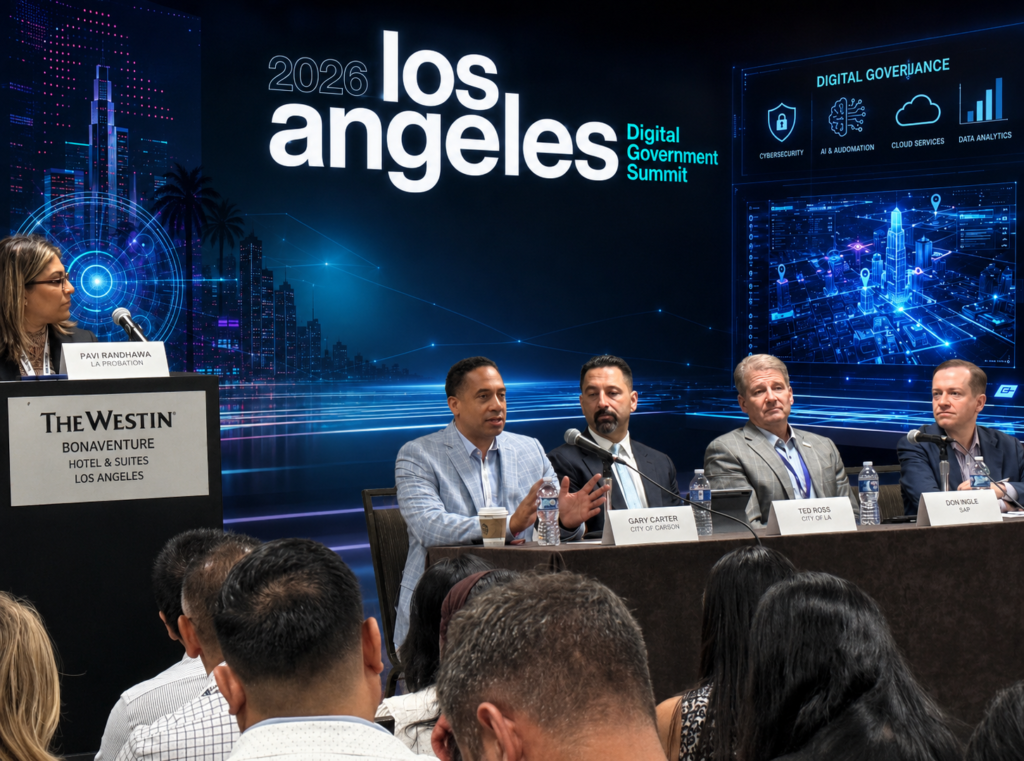
2026 Los Angeles Digital Government Summit “Modernizing Core IT Services: From 311 to Everyday Operations” Panel (L to R): Gary Carter, Director, Information & Security, City of Carson; Ted Ross, Chief Information Officer, City of Los Angeles; Don Ingle, Industry Executive Advisor, SAP; Leo Zhadanovsky, Chief Technologist, Amazon Web Services. Moderated by (far left) Pavi Randhawa, Director, Infrastructure and Operations Management, Probation Department, County of Los Angeles.
Carson, CA — Technology is often most noticeable when it does not work. A website is difficult to navigate. A service request gets delayed. An internal approval sits unattended. Residents struggle to locate information or determine which department can solve a problem.
For Gary Carter, Carson’s director of Information Technology and Security, effective government technology should produce the opposite experience: services that are accessible, secure and responsive—often without residents realizing how much work is happening behind the scenes.
Since joining Carson, Carter has helped lead a broad modernization effort touching nearly every city department. His work includes the Carson 311 mobile application, the city’s redesigned website, expanded online programming through Carson TV, stronger cybersecurity protections, artificial intelligence tools and development of a municipal fiber-optic network.
Yet Carter’s approach to technology did not begin with computers. It began with risk.
Carter started his career in the private sector, working in risk management and using data to help major companies identify and reduce potential losses. While working for Travelers Insurance, he collaborated with the company’s technology team to improve proprietary software used to analyze evolving risks.
The assignments were practical and varied: helping businesses reduce workplace injuries, prevent foodborne illness and identify quality-control problems before they became larger and more expensive.
“I got into IT really from a business-analysis perspective,” Carter said. “I wound up being a part of software development. I thought it was fun. I loved it, and I loved the impact.”
The work was successful, but Carter eventually began searching for something that private-sector accomplishments could not provide.
“It was all about the shareholders, and I just felt like there was something missing in my life, career-wise,” he said.
Raised in a family committed to civil rights, social justice and community building, Carter saw public service as an opportunity to connect his technical abilities with a larger purpose.
That opportunity came through the City of Santa Monica, where he was hired to help turn an internal fiber network into a revenue-producing municipal service. Carter entered the position without a traditional networking background, but he applied research, business principles and what he described as “a lot of hustle, grit and effort.”
Within six months, the city launched broadband services for businesses. The network would eventually serve companies and institutions that included Google, gaming businesses and the UCLA Health System. Carter said the operation was profitable from its first year and later generated approximately $3 million annually.
He also helped build the team from one employee into a larger operation and assisted dozens of public agencies with technology and broadband projects. During the COVID-19 shutdown, the team helped deploy Verizon’s 5G network throughout Santa Monica.
Still, Carter wanted the chance to build at a higher level—and in a community where technological progress would be deeply felt.
He found that opportunity in Carson.
Carter said Carson reminded him of the blue-collar community where he was raised on the East Coast: hardworking families, industrial surroundings and residents whose expectations for themselves were not defined by how outsiders perceived their city.
“What I love with Carson was it reminded me of my hometown,” Carter said. “Good people, blue collar, hardworking—and where you come from doesn’t limit your opportunity.”
He also noticed something important in his interactions with residents: appreciation.
Community members have approached him at city events, offered hugs and thanked him for the improvements they have seen. Carter said that connection motivates him to work even harder.
“The fact that the community really appreciates it makes you want to work even harder,” he said. “I’m like, ‘I haven’t gotten started yet.’”
Carter credits Carson’s leadership with assembling what he calls an “all-star executive team” focused on stronger performance and modern municipal practices. Rather than inheriting an already-finished operation, he sees himself as part of building the city’s next chapter.
One of the most visible improvements has been Carson 311, a mobile application that allows residents to report issues directly to the city.
Before the application, residents might call a councilmember about a pothole or another neighborhood concern. That report would then need to travel through several people before reaching the employee responsible for addressing it.
Through Carson 311, a request is logged, time-stamped and routed to the appropriate team. Residents can receive updates and be notified when the matter is resolved. If the city cannot immediately complete the request—because an entire street is scheduled for repaving, for example—the system gives staff a way to explain the reason.
Carter said the system reflects three priorities that run throughout his work: transparency, efficiency and accountability.
“It allows our residents to be the eyes and ears,” he said. “As soon as they submit the issue, it’s tracked, it’s time-stamped, it’s logged and it needs to get routed.”
The city has also completed a redesigned public website that is mobile-friendly, accessible to users with disabilities and capable of translating information into more than 100 languages. Residents can use the website to find programs, register children for activities, reserve facilities, watch City Council meetings and locate other city services.
The “Ask Carson” AI-powered chatbot provides another way for visitors to search for information. Carson TV extends city programming to Roku, Apple TV and mobile devices, giving residents additional access to council meetings, community events and locally produced content.
City Wi-Fi is already available at Carson parks, with improvements expected as the municipal fiber network advances.
Under Carter’s leadership, information technology has grown from a city division into a department with specialized areas focused on infrastructure and security, client support and user experience, data and digital intelligence, and project management.
That structure reflects the growing role technology plays in nearly every city service. It also gives cybersecurity a more prominent place within Carson’s operations.
Carter said the city has upgraded its firewall and network infrastructure, established a third-party 24-hour security operations center and partnered with the federal Cybersecurity and Infrastructure Security Agency to identify and address potential vulnerabilities.
Because employees are often the first line of defense against phishing attempts and other cyber threats, the city has also prioritized security-awareness training.
“You know that it’s just a matter of when,” Carter said of potential cyber incidents. “We train our staff to always be prepared and to take each day and ask, ‘What can you identify to reduce that risk?’”
For Carter, cybersecurity readiness also requires planning for the unexpected: What happens if a key employee is unavailable? Who steps forward during an incident? What information and outside partnerships will the city need?
“If you stay ready, you don’t have to get ready,” he said.
Carson is also investing $27 million in the first phase of a municipal fiber-optic network that Carter believes can strengthen digital access and help attract new industries.
The city plans to offer broadband service in the new Lennar residential development at the Carson Triangle. Over time, the infrastructure could improve connectivity at parks, public facilities, homes and commercial properties.
Carter believes the network can also strengthen Carson’s economic-development strategy by making the city more attractive to technology, gaming, healthcare and other data-dependent businesses.
“A tech company wants to come here? Of course, we’re ready for you,” Carter said. “That matters.”
Carson is installing portions of its broadband infrastructure while streets are already being improved, allowing the city to coordinate investments instead of repeatedly disrupting the same areas.
The city is also exploring artificial intelligence cautiously and with a focus on solving specific problems. Carter said Carson is developing a document-management pilot with Google and Amazon that could make it easier for residents to locate public documents and submit public-records requests.
The City Clerk’s Office is a key partner in the project. Carter said the goal is not to introduce AI simply because it is available, but to improve a process that often falls short of what residents need.
Additional possibilities include applying AI to the city’s geographic information system so staff can retrieve maps and location-based data more quickly—an increasingly important capability as Carson prepares for major regional events, including the 2028 Olympic and Paralympic Games.
Carter recently brought Carson’s experience to the 2026 Los Angeles Digital Government Summit, where he joined public-sector technology leaders for a panel titled “Modernizing Core IT Services: From 311 to Everyday Operations.”
The summit brought together government and industry leaders to discuss cybersecurity, artificial intelligence, data governance and digital service delivery. Carter appeared alongside City of Los Angeles Chief Information Officer Ted Ross and technology leaders from SAP and Amazon Web Services. The summit’s official agenda described the session as a discussion of practical ways agencies are modernizing resident services and internal workflows to achieve measurable results.
Carter highlighted Carson’s Personnel Action Workflow, or PAW, system as an example of how an internal technology improvement can produce citywide results.
The PAW system digitizes and tracks employee actions such as hiring to fill vacancies, promotions, long-term leaves of absence, salary adjustments and retirements. According to Carter’s presentation summary, the new workflow reduced the average processing time for employee changes to approximately two days from start to finish.
The improvement helps Carson make better use of its budgeted full-time positions by reducing administrative delays and allowing departments to fill vacancies more quickly.
Carter’s participation also carries a broader message for Carson residents: the city is no longer simply looking to larger municipalities for ideas. In some areas, other agencies are now looking to Carson.
“We are working to be the leader,” Carter said during the interview. “Why are you asking Long Beach? They’re asking me.”
For all his focus on systems and infrastructure, Carter repeatedly returned to one leadership priority: people.
The city’s new website, for example, was completed with significant support from interns working under experienced staff. Carter views internships as more than temporary assistance. He wants participants to receive meaningful assignments, professional exposure and a path toward full-time employment—even if their next opportunity is outside Carson.
Several interns have gone on to secure full-time positions. One former intern later returned to Carson after gaining experience elsewhere.
“If you went through here, you got exposed to an opportunity and you get a full-time job with benefits right out of college—goodbye,” Carter said. “That’s what we want.”
He brings the same philosophy to permanent employees, working to ensure team members are trained and prepared to take on larger responsibilities.
Carter compares his department to a professional sports team. There may be 11 starters on the field, but every player must be prepared. When someone is unavailable or a new challenge arises, a person previously considered a “bench player” may suddenly be asked to lead.
His goal is to build a high-performing technology team whose members feel connected to Carson’s public-service mission.
Asked which accomplishment makes him most proud, Carter paused.
There are several contenders: the redesigned website, Carson 311, cybersecurity improvements, national recognition and the City Council’s commitment to the fiber network.
But Carter is not ready to select one.
“I’m still waiting for that moment,” he said. “We’ve done a lot, but I don’t think we’ve done our best just yet.”
That answer does not diminish what the department has accomplished. Instead, it captures the standard Carter applies to himself and his team: appreciate the progress, then return the next day prepared to improve upon it.
“We’re putting the pieces together,” he said.
For Carson residents, many of those pieces are already becoming visible—in a service request that reaches the correct department, a website that works on a cellphone, public information available in multiple languages and infrastructure designed to support opportunities that have not yet arrived.
Carter’s work may be rooted in technology, but his measure of success is ultimately human: whether city government works better for the people it serves.
____