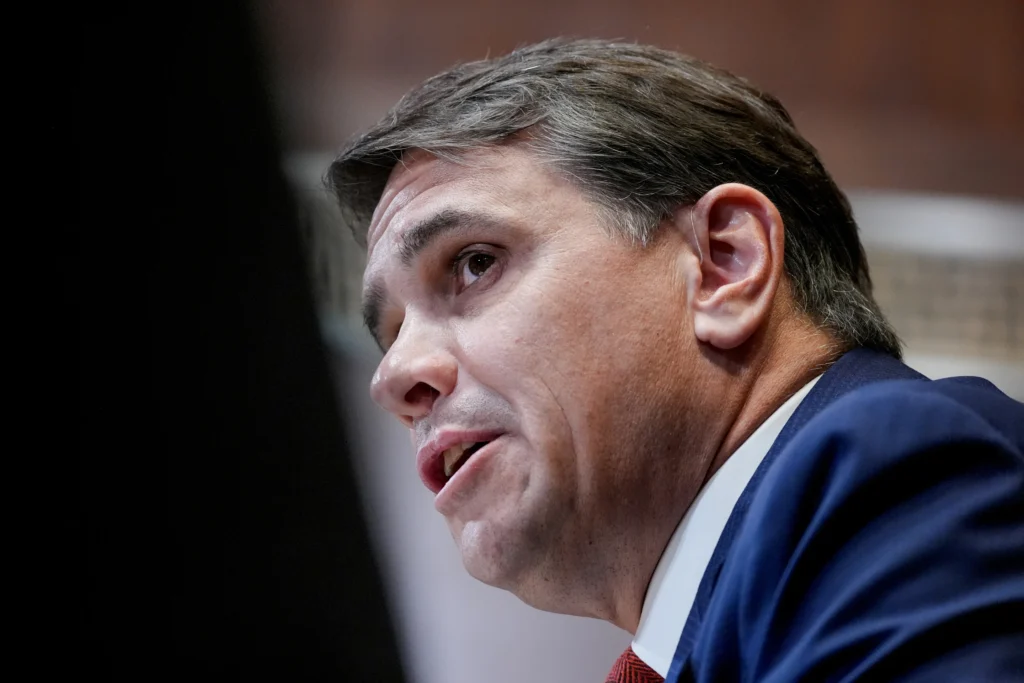
Acting Attorney General Todd Blanche testifies during a Senate Committee on Appropriations subcommittee hearing to address the Trump administration’s budget request for the Justice Department, Tuesday, May 19, 2026, on Capitol Hill in Washington. (AP Photo/Mariam Zuhaib)
Washington, D.C. — A controversial proposal by the Trump administration to create a $1.776 billion compensation fund for Americans who claim they were victims of political “weaponization” is igniting fierce debate across the country, particularly after Acting U.S. Attorney General Todd Blanche refused to rule out payments to individuals convicted in connection with the Jan. 6 Capitol riot.
The issue took center stage Tuesday during a tense Congressional budget hearing in which Blanche appeared before lawmakers for the first time since assuming leadership of the Justice Department following the departure of former Attorney General Pam Bondi.
What began as a routine hearing on the Justice Department’s budget quickly escalated into a broader political and constitutional clash over the future independence of federal law enforcement, the legacy of Jan. 6, and growing accusations that both political parties are using the justice system to target opponents.
At the center of the controversy is the administration’s newly announced “Anti-Weaponization Fund,” which would allow individuals who believe they were unfairly investigated, prosecuted or politically targeted by prior administrations to seek financial compensation from the federal government.
Lawmakers repeatedly pressed Blanche on whether people convicted of violently attacking police officers during the Jan. 6, 2021 assault on the U.S. Capitol would be eligible to receive taxpayer-funded compensation under the program.
Rather than offering a direct exclusion, Blanche said all applicants would be evaluated by an independent five-member commission appointed by the attorney general.
“What I will commit to is making sure the commissioners are effectively doing their jobs,” Blanche told lawmakers. “That includes setting appropriate guidelines.”
The answer immediately sparked outrage among Democratic lawmakers, who accused the administration of attempting to rewrite the history of Jan. 6 while financially rewarding individuals tied to one of the most consequential attacks on American democracy in modern history.
“This is an abuse of public funds,” Sen. Chris Van Hollen (D-Maryland) said during the hearing. “Rewarding individuals who committed crimes against law enforcement officers and against the Capitol itself is obscene.”
Other lawmakers described the proposal as politically motivated retaliation disguised as reform.
The debate underscores the growing divide in how Americans view Jan. 6 more than five years after thousands of Trump supporters stormed the Capitol in an effort to disrupt certification of the 2020 presidential election.
For critics of the administration, the proposed compensation fund represents the latest effort to recast Jan. 6 defendants not as participants in a violent attack, but as victims of political persecution.
That reframing has intensified in recent months following President Donald Trump’s pardons and sentence commutations for multiple individuals convicted in connection with the riot, along with the dismissal of some prosecutors involved in those cases.
Blanche defended the proposal Tuesday by arguing the compensation program is not limited to Republicans or Jan. 6 defendants and could theoretically apply to anyone who believes they were subjected to politically motivated investigations — including figures prosecuted during the Biden administration.
“It’s not limited to January 6th defendants,” Blanche said. “It’s limited only by the term weaponization.”
Still, administration officials have yet to clearly define what “weaponization” actually means within the framework of the program, leaving legal experts and lawmakers raising concerns about how the fund would operate and who would ultimately qualify.
The administration says the money would come from the federal judgment fund, traditionally used to settle legal claims and lawsuits against the federal government.
Critics argue the proposal could create a dangerous precedent by opening the door for politically aligned individuals to seek taxpayer compensation based largely on ideological claims rather than proven misconduct.
Supporters of the initiative, however, say the program is necessary to restore trust in federal institutions after years of political division and allegations that the Justice Department unfairly targeted conservatives under previous administrations.
The hearing also exposed unease among some Republicans.
Senate Majority Leader John Thune acknowledged concerns about the proposal, telling reporters he was “not a big fan” of the idea and questioning its purpose. Louisiana Sen. Bill Cassidy reportedly went even further, calling the initiative a potential “slush fund.”
The controversy arrives at a time when public confidence in government institutions continues to erode nationwide. Questions surrounding political influence, selective prosecutions, media narratives and government accountability remain deeply polarizing issues as the country moves closer to another contentious election cycle.
Political analysts say the debate surrounding the compensation fund is likely to become another flashpoint in the broader national conversation over justice, political retaliation and the role of federal power in an increasingly divided America.
For many Americans, the issue goes beyond Jan. 6 itself. It reflects a deeper concern over whether the justice system can remain independent in an era where political loyalty and legal accountability are becoming increasingly intertwined.
As Congress continues demanding answers from the Justice Department, the proposed fund is expected to face intense legal and political scrutiny in the months ahead.