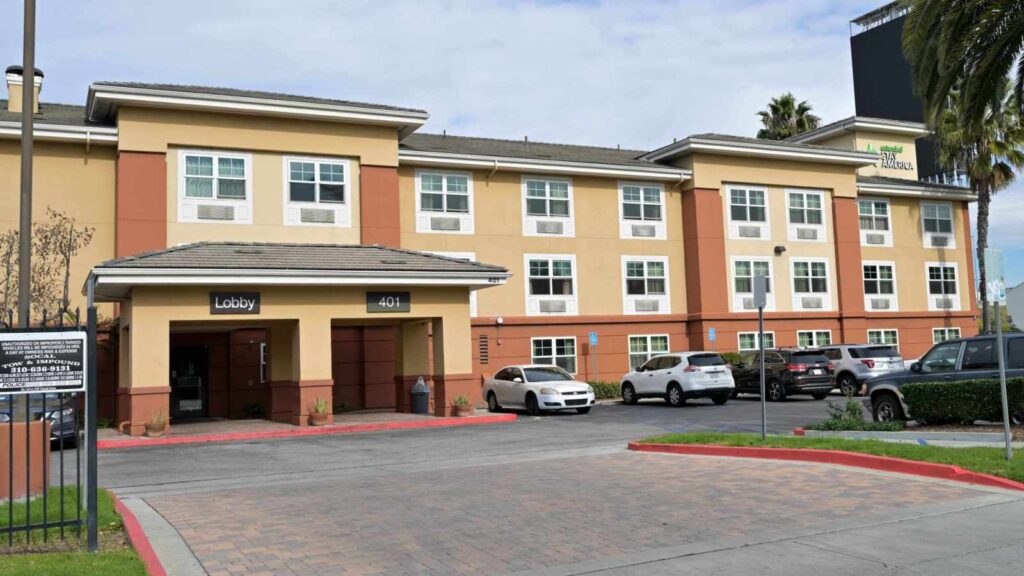
The Weingart Primrose Project, a housing development backed by California’s Project Homekey, is facing controversy after the acquisition of a former Extended Stay America hotel in Carson that is slated to be converted into 107 residential units for the unhoused.
Carson, CA- Carson residents expressed strong opposition yesterday at the Los Angeles County Board of Supervisors Meeting after the Weingart Center proposed converting a former hotel in Carson into apartments for unhoused individuals, rather than reserving units for California State University, Dominguez Hills (CSUDH) students.
The Weingart Primrose Project, a housing development backed by California’s Project Homekey, is facing controversy after the acquisition of a former Extended Stay America hotel in Carson that is slated to be converted into 107 residential units for unhoused individuals. The project has since become a major focal point of debate throughout Carson.
Carson residents have raised concerns about the proposal, focusing on housing priority, transparency, and the potential impact on the surrounding community.
On May 21st, community members gathered around the site, demanding a model solution for the prioritization of 1,500 unhoused students attending CSUDH. Carson City Manager David Roberts claimed that there had been an agreement between him and Weingart CEO, Kevin Murray, to use the housing to prioritize unhoused students. However, agreements have been dismissed after a leadership change occurred in November 2025.
Data from the CSUDH Toro Cares Program shows that about one-tenth of the student body is experiencing housing security or homelessness. Some community members argue that prioritizing this population could improve academic success and stability for affected students.
Community members later brought their concerns directly to county officials during the June 23rd Board of Supervisors meeting.
Prior to public comment, LA County Supervisor Holly J. Mitchell distributed an open letter to Carson residents attending the meeting. The letter aimed at answering frequently asked questions about the project and clarifying details about the project that had previously led to confusion.
The letter stated that the building cannot legally house only CSUDH students, as doing so would violate fair housing laws and related restrictions. It went on to explain when the deal began, when the site was selected, when Carson city officials were informed, and how Weingart intends to address community safety.
Still, Carson residents continued to voice their concerns on the proposal during public comment.
Derrick Mims, Director of Government and Community Relations at CSUDH, urged Carson and LA County officials to collaborate and support unhoused students.
Carson resident Robert Lesley, drawing from experience as a police officer throughout LA County, also criticized the project. “Those programs are designed not to rehabilitate, evaluate, and give housing, but create more impact on law enforcement in the community,” he said.
Another resident, Vivian Hatcher, expressed concerns about the project’s potential impact on the surrounding area. “I am very appalled and very unhappy about the project that is coming to Carson,” she said. “This is going to impact business, the children and the community. I wish you would consider Cal State students [before] the project.”
Dr. Ta-Taneisha Thames last spoke regarding the issue, responding to the letter distributed prior to public comment. “I’m asking for transparency,” she began. “County correspondents stated that providing housing exclusively for Cal State Dominguez Hills Students would violate federal fair housing laws. I’m respectfully asking that the county identify the specific statute, regulation, Homekey requirements, regulatory agreement, or deed restrictions/conveyance that supports that statement.”
As discussions continue, the Weingart Primrose Project remains a central issue between the Carson residents and constituents and the County of LA. Residents, advocates, and city officials are now seeking a resolution before the operation is final. Additional meetings and community discussions are expected as stakeholders work to address ongoing concerns and clarify the project’s next steps.
___________
Article Written By: Julissa Wilson, Carson Compass