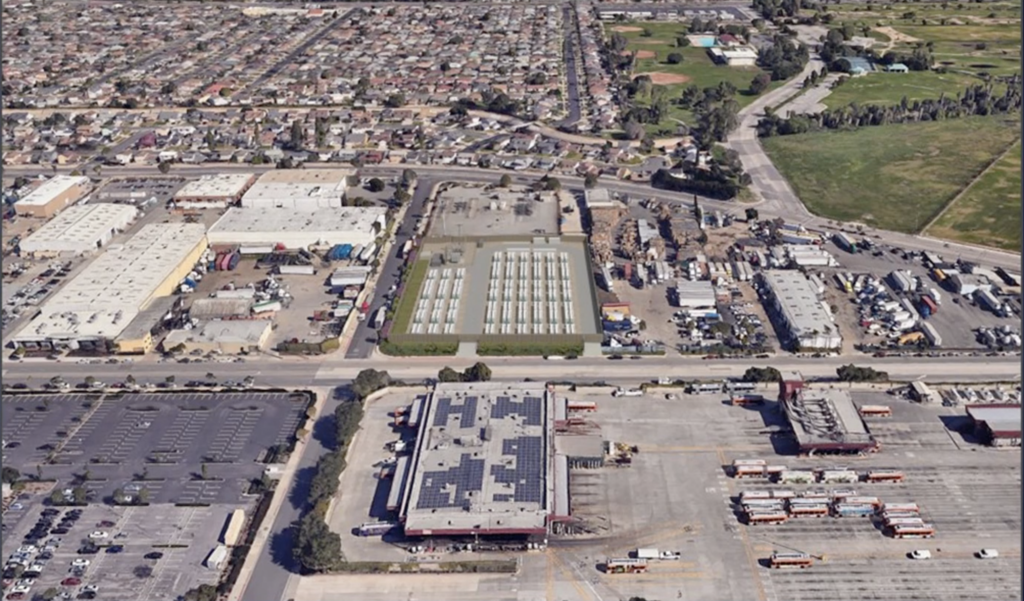
Screenshot of the rendering of the newly approved battery energy storage system site located at 18800 Broadway Ave. on the southeast corner of Griffith St. and Main St. that was presented on 3/10/2026 at the city of Carson Planning Commission meeting.
Carson CA — The Carson City Council has given final approval to the Griffith Battery Energy Storage Project, advancing amajor clean energy and grid reliability investment in the City of Carson. The Council’s action on May 20 cleared the way forOrmat Technologies to begin construction on the approximately 100-megawatt battery energy storage system on a vacantindustrial site at 18800 Broadway Avenue.
The Griffith Energy Storage project is designed to store electricity and dispatch it when demand is high, renewable generationis intermittent, or additional grid support is needed, reducing the likelihood that blackouts and brownouts will pose a negativeimpact on local community members.
In voting for the project, the council also approved the development agreement negotiated by the supportive members of theCity Council. That agreement will provide a minimum of
$2 million in benefits to the Carson community. Previously, the project had been signed off by the LA County FireDepartment after extensive review and the addition of multiple layers of safety to protect the local community.
“The City of Carson has been among the leaders in the transition to clean energy, and we look forward to accelerating thatforward momentum toward a greener, more resilient
power grid,” said Kyle Snyder, Energy Storage Vice President, Business Development at Ormat Technologies. “Our utmostappreciation goes to the City Council members who voted to approve our project and the community members whoactively supported our project at multiple community meetings and hearings.”
Supporters of the project included Carson residents, the nearby Towne Avenue Elementary School, the Sierra Club, localtradespeople, the Carson Chamber of Commerce, local
businesses, and Collab CDC.
In voicing their support, Julia Dowell of the Sierra Club said: “Carson residents deserve clean air and a healthierenvironment. Unlike nearby fossil fuel facilities, which emit harmful pollutants and have contributed to Carson beingamong the most overburdened communities in the state, energy storage facilities produce no emissions during operation.Importantly, the Griffith project is proposed on already industrialized land, minimizing impacts to the natural environmentand avoiding disruption to open space or sensitive habitats. Advancing projects like Griffith Energy Storage represents ameaningful step
toward environmental justice for neighborhoods that have long borne a disproportionate share of pollution.”
With its approval and at the direction of the motion by Councilmember Arlene Rojas and seconded by CouncilmemberJawane Hilton, the project will additionally include:
- Increased perimeter wall protections
- Mandatory annual safety meetings
- Emergency evacuation planning
- A 24-hour public hotline
- Community benefit investments for schools, job training and youth programs, and Olympic-related events
“I do not make this decision based on fear, speculation, or what-if scenarios,” said
Councilmember Jawane Hilton in voting for the project. “I make decisions based on facts, evidence, and expert analysis.”
The Griffith project in Carson joins dozens of other battery storage investments in local communities around the state,including projects and proposals in Carpinteria, Long Beach, Redondo Beach, and Los Angeles. As California transitionsoff of fossil fuels, battery energy projects like these fill a key gap in reducing emissions that have harmed local communities for decades.
In approving the project, the City Council avoided losing local control of the project and ceding that authority to the State toapprove the project while achieving significant community benefits for Carson. Just earlier this week, the California EnergyCommission approved the Potentia-Viridi BESS project in eastern Alameda County, which is approximately eight times thesize of the Ormat proposal in Carson. The state only required a maximum of $1.1 million in community benefits for thePotentia-Viridi project, less than half of what Ormat will provide in Carson for a tremendously smaller project.
Mayor Lula Davis Holmes, along with Mayor Pro Tem Cedric Hicks, chose to oppose the project after Mayor Holmes hadpreviously expressed support for the project at the 2024 State of the City event, at the time hailing battery storage projects astransformative investments for Carson’s future.
The mayor previously framed the projects as critical infrastructure designed to stabilize the electrical grid, prevent blackouts,and advance Carson’s environmental goals.
At that time, the Mayor shared in her speech: “By balancing electricity supply and demand, these facilities contribute to gridstability and resilience. They can provide additional power during high demand and help prevent blackouts.”