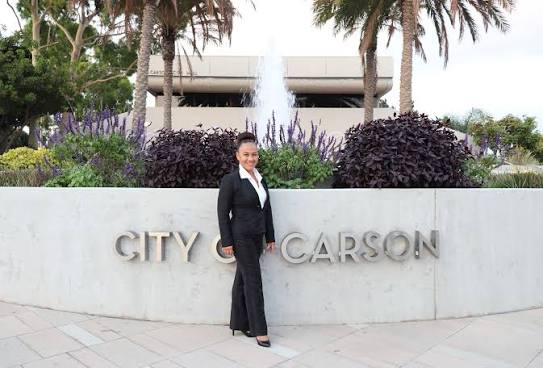
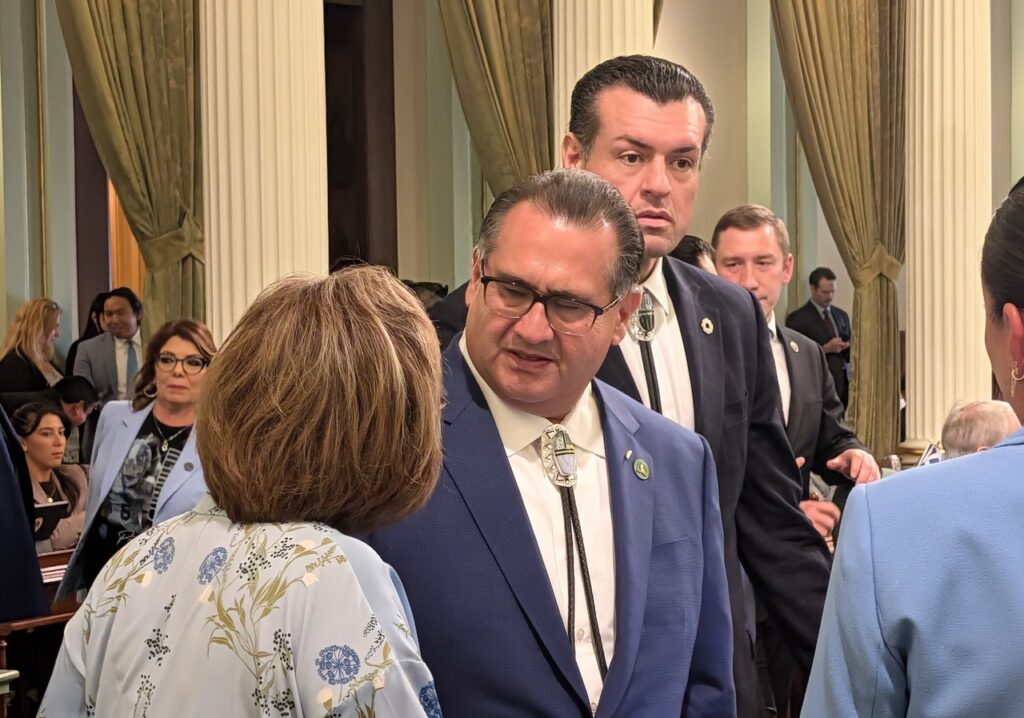
Assemblymember James C. Ramos (D-Highland) introduced Assembly Bill 2115, which would formally apologize for California’s role in promoting, permitting and enforcing policies of violence against California Native Americans. Named in honor of Ramos’ late mother, Rowena Mae Ramos, the legislation is known as the Rowena Mae Ramos Act. / CBM photo by Antonio Ray Harvey.
Two years after the California Legislature formally apologized to Black Californiansfor the state’s role in slavery and systemic discrimination, lawmakers have approved a parallel acknowledgment of atrocities committed against Native Americans.
Assembly Bill 2115, authored by Assemblymember James C. Ramos (D-Highland), passed the Assembly on Aug. 26 by a unanimous 79-0 vote after clearing the Senate 40-0. Enrolled Aug. 30, the measure awaited action by Gov. Gavin Newsom as of Sept. 7.
The measure closely mirrors AB 3089, the 2024 reparations-package bill apologizing to Black Californians for California’s role in perpetuating chattel slavery and systemic discrimination. Both measures require plaques memorializing the apologies to be prominently displayed in the State Capitol.
California Legislative Black Caucus (CLBC) member Sen. Laura Richardson (D-Inglewood) emphasized the importance of the plaque.
“The permanency (of the plaque) is so important that (Indigenous) people will continue to be remembered and recognized and do better,” Richardson said during a Senate committee hearing.
The connection extends beyond the plaques. During California’s formative years, the state enacted laws authorizing violence, forced labor and land theft against Native Americans while denying Black Californians fundamental rights and enabling slavery in a state admitted to the Union as “free.”
California’s first governor, Peter Hardeman Burnett, called for a “war of extermination” against Native Americans. During the same era, California enforced fugitive slave laws, permitted enslaved people to be held within its borders and prohibited Black residents from testifying against White people in court.
“In 1851, California’s first governor, Peter Burnett, addressed the Legislature where he openly declared a war against California’s first people,” said Ramos, a member of the Serrano/Cahuilla tribe and the Yuhaaviatam of San Manuel Nation. “That war was paid for using taxpayers’ dollars to eliminate the Native American people of this land.”
Formally known as the “Rowena Mae Ramos Act,” AB 2115 states that California recognizes and accepts legal and moral responsibility for harms and atrocities committed against Native Americans by public officials since 1850.
“This history of violence against California’s first people created deep and lasting trauma that continues to this day and affects Native American communities across our state,” Ramos said.
“Although the governor issued an apology on behalf of the state in 2019, this body, this institution, which enacted laws that facilitated the removal and destruction of Native communities, has never issued its own apology for its direct role in these injustices,” Ramos added.
Newsom’s 2019 executive order apologized on behalf of the executive branch and established the California Truth and Healing Council. AB 2115 would add the Legislature’s acknowledgment of its responsibility for violence, forced displacement, land theft, cultural suppression, family separation and the erosion of tribal sovereignty.
If signed, the apology would bear the Great Seal of the State, be signed by state leaders and remain permanently in the State Archives, Ramos told California Black Media (CBM)/
“While we cannot undo the wrongs of the past, the state has a responsibility to confront it with honesty and pave the way for the true account of history to be told,” Ramos said.
AB 3089, authored by former Assemblymember Reggie Jones-Sawyer (D-South Los Angeles), was signed Sept. 26, 2024. Although California entered the Union as a free state in 1850, more than 2,000 enslaved African people were brought into the state between 1850 and 1860, according to the law. California courts enforced fugitive slave laws until 1865, while lawmakers opposed federal civil rights laws and delayed ratifying the 14th and 15th amendments.
On June 23, Kenneth Kahn, tribal leader of the Santa Ynez Band of Chumash Indians, testified that California laws targeting tribal communities “were not abstract or distant.” They stripped Native people of “basic civil protections” and made many tribes’ survival “extraordinarily difficult,” he said.
“These harms were the direct result of state-sanctioned policies adopted and maintained during California’s early history,” Kahn said. “In 2019, Gov. Newsom took an important step by issuing an apology on behalf of the executive branch and establishing the Truth and Healing Council. But as AB 2115 correctly recognizes, the violence and discrimination inflicted upon Native communities were not confined to executive action alone.”
Ramos, the first Native American elected to the Legislature, said educating lawmakers was crucial.
“It’s very special. One of the main processes of getting this passed was educating the Legislature that these things actually did happen,” Ramos said.
The bill honors his mother, Rowena Mae Ramos, a tribal elder who taught Native American history and culture.
“My mom grew up at a time when racism wasn’t hidden. She went through a lot,” Ramos said. “I thought that it was only fitting to honor her with this bill, a formal apology on behalf of the state of California, that would now carry her name.”