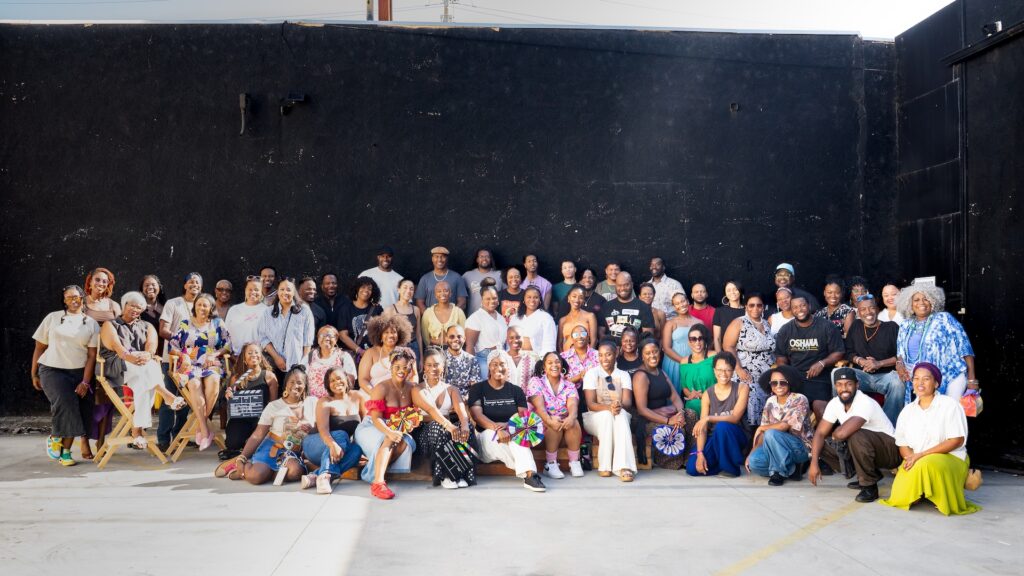
Members of Los Angeles’ Black theatre community gather for the annual Black Theatre Day community photo at Give Hope Studios in Boyle Heights on September 12, 2026. / Photo by Kamal Bolden.
When was the last time you sat in a room and watched somebody tell a story that felt like yours?
A story where nobody had to explain the joke. Where the family sounded familiar. Where church could be complicated, the beauty shop could be sacred and the music could take you somewhere before anybody said a word.
Those stories are being told across Los Angeles, often in small theatres many Black Angelenos have never stepped inside.
On September 12, Black theatre makers from across the city gathered at Give Hope Studios in Boyle Heights for an annual community photograph celebrating Black Theatre Day, observed September 17. More than 130 people filled the frame last year.
Black Theatre Day reaches back to September 17, 1821, when William Alexander Brown’s African Grove Theatre launched its first season in New York. Recognized as the first professional Black theatre company in the United States, it created space for Black performers and audiences when mainstream stages would not.
Two hundred years later, Dr. Monica White Ndounou, founder of The CRAFT Institute, created Black Theatre Day as an annual day of solidarity and service, calling attention not only to celebrating Black theatre, but supporting the institutions that keep it alive.
That call matters in Los Angeles. Some of our rawest, funniest and most unapologetically Black stories aren’t happening in thousand-seat theatres. They’re happening in 99-seat houses, neighborhood playhouses, bookstores and intimate rooms where an actor can look you directly in the eye.
These stories start in our communities, from within our homes, told without translation and transformed into impactful and necessary productions in theatres and organizations like Willie Agee Playhouse, WACO Theater Center, Ebony Repertory Theatre and The Robey Theatre Company. However, artists can’t sustain that tradition alone.
Actress and producer Sophina Brown founded Support Black Theatre around strengthening Black theatres, developing artists and cultivating audiences. Through efforts including its L.A. Black Creators Summit, the organization has helped bring artists, cultural workers and community together around a larger question: How do we make sure Black theatre doesn’t just exist, but thrives?
Part of the answer is us. This year’s Black Theatre Day photo was organized through the Sankofa Theatre Alliance, made up of Bottle Tree Theatre Company, Black Creators Collective and Oshana Arts.
For Bottle Tree founders Chelsea Boyd, Jaquita Ta’le and Kacie Rogers, preserving Black stories is personal.
“History, especially the history of people of color, is always under threat of erasure,” the company says. For them, storytelling carries both the responsibility and honor of preserving our history and passing it forward.
Their mantra is “No Sorries.” Come whole. Come Black. No apology necessary. Maybe that invitation belongs to the audience, too.
On September 20, Bottle Tree will host their monthly storytelling event “The Cicada” at Lore in Leimert Park, bringing people from across the Black diaspora together around true, personal stories. On October 25, LaDarrion Williams’ Coco Queens opens at Outside In Theatre in Highland Park, placing four Black women inside a 1975 Alabama beauty shop filled with food, music, laughter, secrets, and truth.
Maybe you don’t consider yourself a “theatre person.” You don’t have to be.
Come because somebody may say out loud something your family has carried quietly for generations. Come laugh at something nobody has to explain. Come hear a story that doesn’t have to translate Blackness before it can get to the truth.
This Black Theatre Day, don’t just celebrate Black theatre. Go experience it. Find one of these intimate spaces, bring somebody with you, sit close to the stage, and hear one of our stories, raw, intimate and unapologetic.