
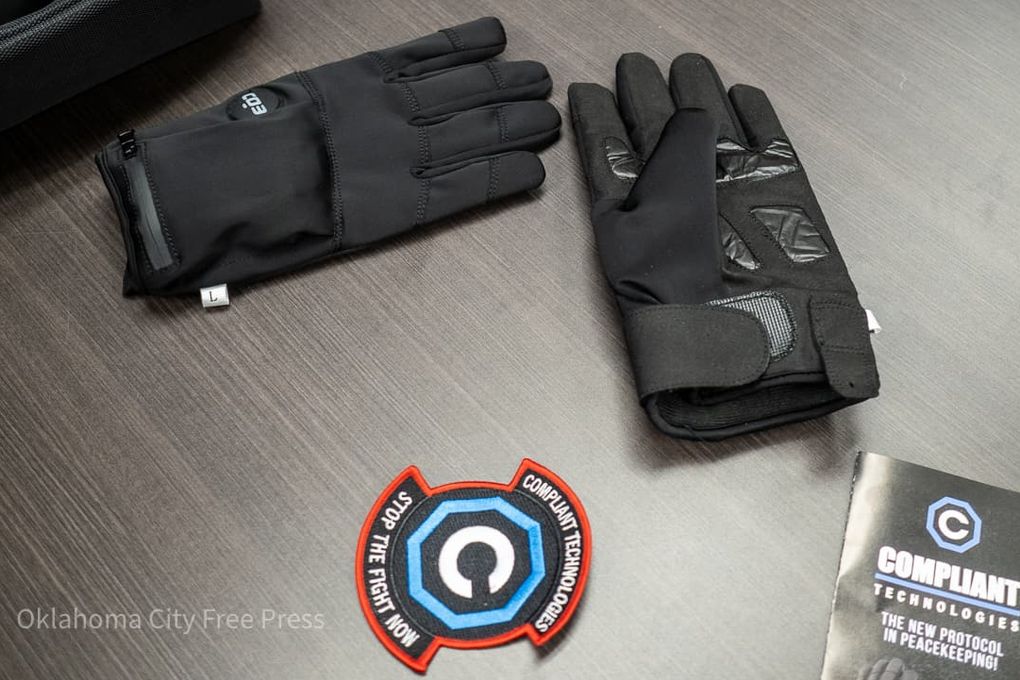
In this photo provided by th Oklahoma City Free Press shows Justin Morris demonstrating the G.L.O.V.E. at the Oklahoma County Detention Center in Oklahoma City, March 22, 2023. / Photo By Brett Dickerson
Immigration and Customs Enforcement is considering a multimillion-dollar purchase of gloves capable of delivering electric shocks, prompting warnings from elected officials, civil rights advocates and law-enforcement experts about the potential for excessive force and abuse.
According to a federal procurement notice, ICE expects to spend between $10 million and $20 million on what the agency describes as “conductive distraction and de-escalation devices.” The size of the proposed purchase suggests the equipment could be distributed widely among ICE officers and agents.
The device, called the G.L.O.V.E.—short for Generated Low Output Voltage Emitter—functions as a standard patrol glove until an officer activates its electrical setting. The glove must touch a person’s skin to deliver voltage intended to cause pain and compel compliance.
Unlike a Taser, the glove is designed not to leave visible burn or contact marks.
The proposal comes as ICE expands immigration enforcement operations under President Donald Trump. Videos of officers using force during arrests, including attempts to remove people from vehicles, have fueled protests and heightened scrutiny of the agency’s tactics.
New York Attorney General Letitia James condemned the proposed purchase and warned that ICE officers could face criminal or civil consequences if they misuse the devices in her state.
The Department of Homeland Security, which oversees ICE, did not address the gloves specifically in a statement. The department said ICE continually evaluates equipment intended to help officers safely conduct arrests and removals, adding that new technology is reviewed for compliance with law-enforcement policies and standards.
Critics, however, say the gloves carry substantial risks—particularly because they are intended to inflict pain without leaving readily visible evidence.
Questions about the equipment’s safety have intensified because of a pending lawsuit involving the 2024 death of a 43-year-old man at a jail in Richmond, Kentucky. The lawsuit alleges the man was shocked 27 times with the gloves and 13 additional times with a Taser.
An internal investigation found that two shocks delivered by the gloves lasted approximately 45 seconds and 99 seconds, substantially exceeding the manufacturer’s recommended 15-second limit. Investigators concluded that the repeated and extended shocks caused unnecessary pain and increased the possibility of serious medical complications, according to court records.
Two other lawsuits have alleged injuries involving the gloves. One involved a man with a heart condition who said he was shocked during a Las Vegas trade show. Another involved a defendant who alleged that he was unnecessarily shocked in court and then ridiculed. Both cases were dismissed.
The manufacturer markets the gloves as nonlethal, but its user manual warns against using them on older adults, small children, pregnant women and people with severe disabilities—groups ICE officers could encounter during immigration operations.
The manual also states that the device should not be used in response to verbal defiance or for punishment, torture or horseplay.
Several Democratic members of Congress, including Reps. Pramila Jayapal, Maxwell Frost and Delia Ramirez, criticized the proposal and argued that ICE does not need another device capable of inflicting pain.
Jayapal said the equipment would not improve public safety and could instead be used against immigrants and U.S. citizens.
Former acting ICE Director John Sandweg also raised concerns, saying the gloves could be easily misused against people who do not present a genuine threat.
Michael Mannheimer, a law professor at Northern Kentucky University who studies police use of force and federal law-enforcement operations, questioned whether having the device immediately available might encourage officers to use it before attempting less forceful alternatives.
The concerns mirror longstanding criticism of other pain-compliance techniques. The manufacturer of the Taser recently discontinued its “drive-stun” feature, which allowed officers to press the device directly against a person’s body, after reports of misuse.
The federal notice indicates that DHS could pursue a no-bid contract for the gloves, with the solicitation potentially beginning as early as Friday. The proposed contract would extend through March 31, 2027.
Compliant Technologies LLC, the company that manufactures the gloves, declined to comment.
For residents in Carson and across Los Angeles County—one of the nation’s most diverse regions—the proposal adds to broader questions about accountability, transparency and the treatment of families during federal immigration enforcement operations. Civil rights advocates say the debate is not simply about whether the gloves are considered nonlethal, but whether sufficient safeguards would prevent them from becoming another tool of unnecessary force.