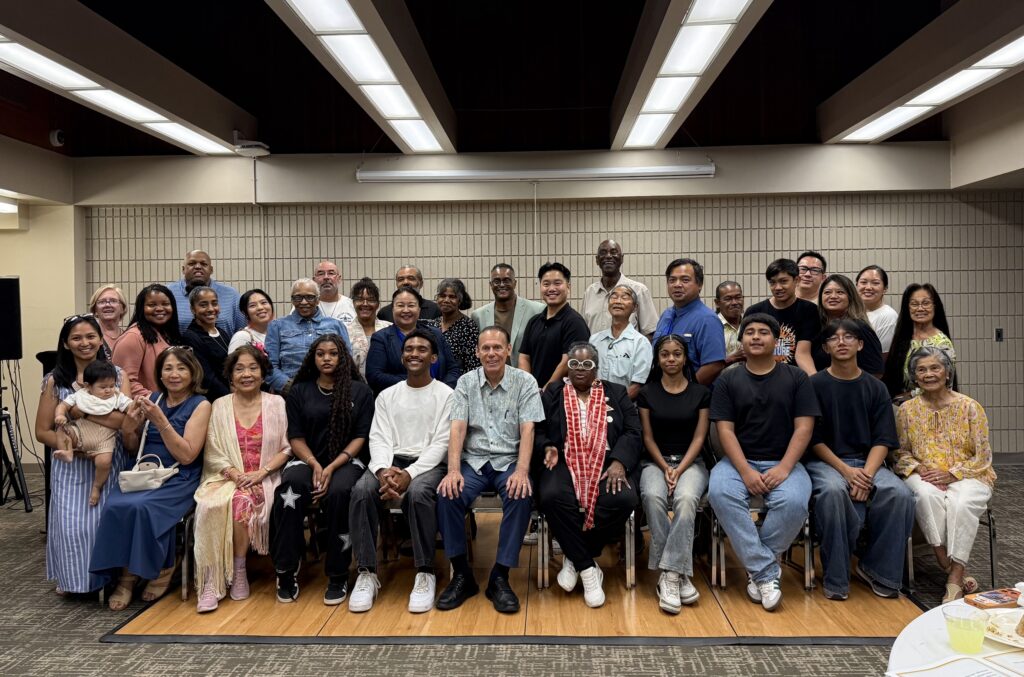
Members of Carson’s 2026 student delegation gather at the Farewell Dinner with Carson’s Councilmember Jim Dear (center), Carson City staff, delegation family, friends, and supporters before departing for a two-week cultural exchange in Soka, Japan. The five students were selected to serve as ambassadors for Carson and will live with host families and learn about Japanese culture, traditions, and daily life.
Five Carson students left home this summer carrying more than luggage. As participants in the Carson Sister Cities Association’s 2026 cultural exchange with Soka, Japan, they also carried the responsibility of representing their families, their cultures and their city.
The students are visiting Soka from July 26 through Aug. 8, living with host families and experiencing Japanese food, traditions and daily life. Association leaders describe them not simply as travelers, but as ambassadors entrusted with introducing another community to Carson.
“You’re not over there just to have fun,” an association leader said. “You’re over there representing and exposing the world to Carson.”
The trip continues a relationship that has connected Carson and Soka for nearly five decades. Yet for the leaders who sustain the program, its purpose extends beyond maintaining an international affiliation. They view cultural exchange as an investment in young people who may one day lead Carson as educators, business owners, elected officials and community advocates.
The Carson Sister Cities Association traces its history to 1972, only a few years after Carson became a city. According to the City of Carson, the community established its first sister-city affiliation with Sinai in the Philippines, followed by Soka, Japan, in 1979; Oyoko, Ghana, in 1980; and Robertsport, Liberia, in 1985.
Carson’s current affiliations are with Soka; Wanju-gun County, Korea; and Parañaque, Philippines. The association is also connected to Sister Cities International, a worldwide network created to encourage cooperation and understanding among communities in different countries.
Dorothy Aloha Ross remembers when Carson students exchanged letters with children in Africa. A teacher at the time, Ross said the translated letters arrived in her classroom with such care that opening each one felt like receiving a gift.
She believes the association was created because Carson’s early leaders understood that the newly incorporated city needed meaningful relationships beyond its own borders.
“Somebody knew that there needed to be some kind of interaction between us and other countries,” Ross said.
The association’s official mission includes promoting unity and goodwill, expanding community awareness and encouraging young people to use their knowledge and skills to advance international understanding.
For Ross, the early opportunity was also about diversity.
“It was to help us learn more about other cultures,” she said. “It allowed us to share with other countries and have them share with us who we are.”
While Carson has formed several international affiliations, its relationship with Soka remains the city’s most active and consistent youth exchange.
Carson students travel to Japan in alternating years, while students from Soka visit Carson during the other years. The reciprocal structure distinguishes a formal sister-city relationship from a less active “friendship city” connection.
When Soka students come to Carson, local families open their homes to them. Students selected to travel to Japan are expected to help host members of a future Soka delegation, ensuring that the exchange is based on mutual hospitality.
In Japan, Carson students generally spend one week with one host family and a second week with another. The arrangement allows them to experience different households and see more than one version of daily life in Soka.
Vice Chair Amirh Hendrickson said she became involved because she wanted Carson’s cultural diversity to be reflected among the young people receiving access to international opportunities.
“I didn’t see my people really getting the advantage of being part of a diverse program like Sister Cities,” she said. “I want our children to be able to travel to different countries and see that the city is willing to step up and fund that. I think it’s our obligation to make sure our children are part of that.”
That goal was reflected in this year’s delegation, which includes three Black students, one Latino student and one Asian student. Ross said it is the first time three Black students have participated in the delegation together.
For association leaders, that representation matters. It allows young people from across Carson’s communities to see international travel and civic ambassadorship as opportunities that belong to them.
Students interested in the 2026 exchange completed a detailed application explaining why they wanted to participate, what they hoped to learn, and how they were already involved in their schools or communities.
They also submitted referrals from teachers, businesses or community organizations and participated in virtual interviews with the selection committee.
The process was intentionally rigorous. Association leaders wanted students who could adapt to an unfamiliar environment, communicate confidently and understand the importance of representing Carson abroad.
Ross, whose three grandchildren previously participated in the exchange, described the 2026 delegation as one of the strongest groups the association has selected.
“On a scale from one to 10, I give them a 15,” she said. “I really feel like they were prepared to represent us as ambassadors.”
Several members of the delegation had already traveled internationally, and two had previously visited Japan. One student studied basic Japanese phrases in preparation for the trip. All five expressed an openness to Japanese food and culture.
Their preparation became especially visible during the delegation’s farewell gathering. Students confidently addressed the audience and performed a dance they developed together in preparation for the cultural program they would present in Japan.
Association leaders saw the moment as evidence of their growth even before the trip began.
The value of the exchange, leaders said, cannot be measured only by the places students visit. Its deeper impact comes from removing young people from their routines and allowing them to discover how other families and communities live.
“The exposure,” one leader said when asked what Carson gains from the program. “When children come back and talk about their experiences and the relationships developed with their students, it’s a win-win—not only for the City of Carson, but for the children.”
Ross has witnessed that transformation within her own family.
One of her grandchildren returned from Japan more open to trying unfamiliar foods and participating in new experiences. Now 27, he continues to enjoy Japanese and Mediterranean cuisine.
The students also return with memories of sleeping arrangements, bathrooms, clothing, music, dance, and family customs that may differ from what they know at home. Participants traditionally receive kimonos and take part in farewell celebrations where the delegations share dances and other elements of their cultures.
“When they came back, we were able to see all the things they had learned there,” Ross said. “They had a different feeling about what it was like to be Japanese.”
For Hendrickson, who works as a travel professional and has accompanied college students on domestic and international trips, the need for early exposure is clear.
She has traveled with students from the Mervyn M. Dymally African American Political and Economic Institute at California State University, Dominguez Hills, including some who had never flown on an airplane or traveled outside their immediate communities.
Those experiences convinced her that international education cannot be reserved for young people whose families already have the means and familiarity to travel.
“You would be surprised—even though they’re in college, some of them had never been on a plane and had never been out of the city,” she said. “It made me realize the need to get involved with our younger students here in Carson.”
Students participating in the Soka exchange are responsible for 50 percent of their transportation costs. The city covers the remaining half, while the association helps with additional program expenses and provides students with spending money.
Community support has also helped ease the cost. At the students’ farewell event, Carson 411’s Founder John Holloway contributed $100 to each student.
Once the students arrive in Japan, host families provide accommodations and many of their daily necessities. Students generally need personal funds only for souvenirs and incidental purchases.
The shared investment makes an international experience more attainable for families who might otherwise consider it out of reach.
The leaders’ commitment to the Sister Cities program is rooted in a larger tradition of community service.
Ross said she learned service through church and later through Delta Sigma Theta Sorority, Incorporated, and other civic organizations. She and her husband, Chester Ross, have spent much of their 57-year marriage volunteering together.
“Every organization I belong to gives back, and almost all of them work with youth,” she said. “I get a really good feeling when I do it, and the people we serve are grateful that you even take time to do something for them.”
Chester Ross said adults have a responsibility to prepare young people for a future they cannot fully anticipate. That sometimes means encouraging them to leave familiar surroundings and accept challenges they initially may not choose for themselves.
“We want our children to grow, and they can’t grow staying at home and staying in their own little comfort zone,” he said. “This experience will make them grow later on in life. They’ll appreciate the time they put into it and the things we did to immerse them in another culture.”
In a time when political and cultural differences frequently separate communities, association leaders believe exchanges such as Carson’s partnership with Soka offer a practical lesson in unity.
“It lets people know that regardless of what your race is, we’re all the same,” Hendrickson said. “We all need to learn to live together, work together, eat together and play together. We can work together as one to get things done.”
Learning about another culture often reveals similarities that stereotypes can hide. Communities may speak different languages or follow different customs, but many share strong commitments to family, tradition, education and caring for one another.
Association leaders believe young people often understand this more naturally than adults. Through food, dance, music, clothing and technology, youth can form connections without becoming preoccupied by the differences that divided earlier generations.
“The youth seem to understand, ‘Let’s do it,’” Ross said. “They are a lot more accepting.”
Asked to imagine the students returning 20 years from now as Carson’s mayor, teachers or business leaders, the association’s representatives did not treat the possibility as far-fetched.
“They will come back as mayor, and they will definitely come back as teachers and be in the workforce,” Ross said.
She hopes they will carry home more than photographs and souvenirs. She wants them to remember how it felt to enter another culture with humility, to represent an entire city and to build relationships with people whose lives initially appeared unfamiliar.
“When they come back 20 years from now, they’ll know how to run a city and how to incorporate all of the people,” she said. “They’ll understand how to work together as one.”
That may be the Carson Sister Cities Association’s greatest contribution. It sends students abroad for two weeks, but it prepares them to see their own community—and their responsibility to it—through a wider lens.
For information about membership, volunteering, business participation or future student exchanges, contact the City of Carson Public Information Office at (310) 952-1740. Additional information is available through the City of Carson’s Sister Cities Association page.